
The Manager’s Guide to Fair and Defensible Pay Decisions
Managers play one of the most influential roles in compensation outcomes, yet many feel underprepared when it comes time to make pay decisions. They are expected to balance performance, budgets, internal equity, and employee expectations, often without clear structure or consistent guidance.
When managers lack the right frameworks, compensation decisions can become inconsistent, difficult to explain, and risky for the organization. Even well-intentioned decisions may create perception gaps, equity concerns, or compliance challenges.
Fair and defensible pay decisions are not about removing manager judgment. They are about providing structure, clarity, and transparency so that decisions remain consistent, explainable, and aligned with organizational priorities.
This guide outlines:
- How managers should approach pay decisions with confidence
- Where bias and inconsistency commonly emerge
- What truly defensible compensation decisions look like
- How modern tools support managers without removing flexibility
1. How Managers Should Approach Pay Decisions
Strong pay decisions begin long before the compensation cycle opens. Managers who approach compensation with structure are more likely to make fair and confident choices.
1.1 Understand Pay Frameworks and Budgets
Before recommending increases or awards, managers should clearly understand:
- Salary ranges and positioning
- Merit or bonus budget allocations
- Organizational pay philosophy
- Performance differentiation expectations
Without this context, decisions tend to rely on instinct rather than strategy.
Effective managers ask:
- Where does each employee sit within their range?
- What level of differentiation is expected between performance levels?
- Are there organizational priorities influencing this cycle?
Understanding frameworks helps managers shift from reactive decisions to informed decision-making.
1.2 Review Performance Objectively
Performance discussions often carry emotional weight. Managers may feel pressure to reward effort, loyalty, or visibility rather than measurable outcomes.
Objective review involves:
- Revisiting agreed-upon goals and expectations
- Assessing outcomes against defined performance standards
- Separating recent events from overall contribution
Managers should avoid making compensation decisions based solely on memory or perception. Structured performance data helps maintain fairness and consistency.
1.3 Apply Guidelines Consistently
Consistency does not mean identical treatment. It means applying the same principles across employees. Managers should consider:
- How increases align with performance ratings
- How decisions compare across their team
- Whether similar performance levels receive comparable outcomes
When guidelines are applied unevenly, even small differences can lead to larger perception gaps later.
2. Bias and Inconsistency Pitfalls
Bias is rarely intentional, but it becomes more likely when decisions lack structure or visibility. Recognizing common pitfalls helps managers make more balanced choices.
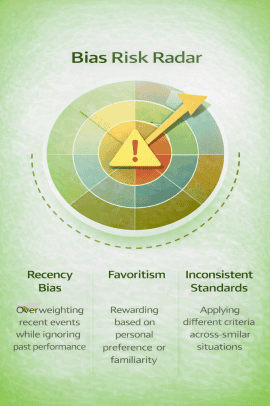
2.1 Recency Bias
Managers may place disproportionate weight on recent events rather than full-cycle performance. Examples include:
- Over-rewarding a recent success
- Penalizing an early-cycle mistake that has already been addressed
Structured performance reviews and calibration discussions help counterbalance recency bias.
2.2 Favoritism and Familiarity Bias
Managers naturally build stronger relationships with some employees than others. Without clear guardrails, these relationships can influence compensation outcomes.
Risks include:
- Rewarding visibility over impact
- Overlooking quieter high performers
- Reinforcing inequity patterns over time
Defensible decisions rely on evidence rather than proximity or preference.
2.3 Inconsistent Standards
One of the most common risks occurs when managers interpret performance standards differently.
Signs of inconsistency:
- One manager labels solid performance as “exceeds expectations” while another uses stricter criteria
- Similar roles receiving very different increases for comparable performance
Calibration and shared rating definitions help maintain fairness across teams.
3. What Defensible Pay Decisions Look Like
A defensible decision is one that can be clearly explained, not only to employees, but also to HR, leadership, or auditors if needed.
3.1 Clear Link Between Performance and Pay
Employees may not agree with every outcome, but they should understand the logic behind it.
Defensible decisions show:
- How performance influenced compensation
- Why outcomes differ between individuals
- How organizational guidelines were applied
When performance and pay appear disconnected, trust declines quickly.
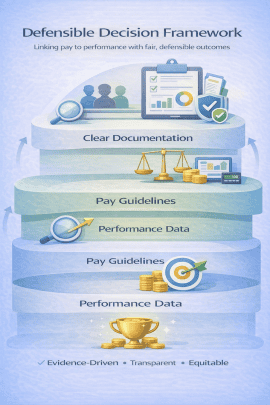
3.2 Documented Rationale
Managers should be able to articulate:
- Why a specific increase or award was chosen
- How the decision aligns with guidelines
- Any contextual factors that influenced the outcome
Documentation protects both managers and organizations by creating transparency and consistency.
3.3 Internal Equity Alignment
A strong decision considers not only individual performance but also team and organizational context.
Managers should evaluate:
- Pay positioning relative to peers
- Market competitiveness
- Equity across roles and demographics
Internal equity is often where defensibility is tested most rigorously.
4. How Tools Support Managers Without Removing Judgment
Modern compensation tools are not designed to replace managers. They are designed to guide them.
4.1 Built-In Guardrails
Digital workflows can:
- Recommend increase ranges based on performance
- Flag outliers or policy conflicts
- Provide reminders of guidelines during decision-making
Guardrails reduce risk while preserving flexibility.
4.2 Budget Visibility
One of the biggest challenges managers face is uncertainty around budgets.
Modern tools provide:
- Real-time budget tracking
- Visibility into remaining allocations
- Early alerts when spending exceeds targets
This allows managers to make confident decisions without last-minute adjustments.
4.3 Audit Trails and Transparency
Defensible decisions require visibility.
Structured systems capture:
- Decision history
- Approval paths
- Changes over time
This reduces reliance on email threads or manual tracking and strengthens organizational confidence in outcomes.
5. Bringing It All Together: A Practical Manager Framework
Managers who make fair and defensible pay decisions typically follow a structured approach:
- Review performance data and outcomes
- Understand budget constraints and guardrails
- Compare decisions across their team for consistency
- Document reasoning clearly
- Participate in calibration to align standards
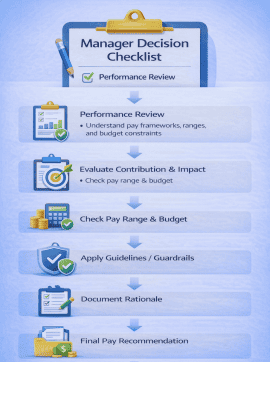
When this process becomes repeatable, compensation decisions feel less stressful and more strategic.