When an employee asks why their offer feels thin compared to a competitor’s, can you show them the full picture?
I’ve watched HR leaders stumble through that conversation, pointing at base salary while ignoring the $15,000 in benefits, flexibility, and development opportunities sitting right next to it.
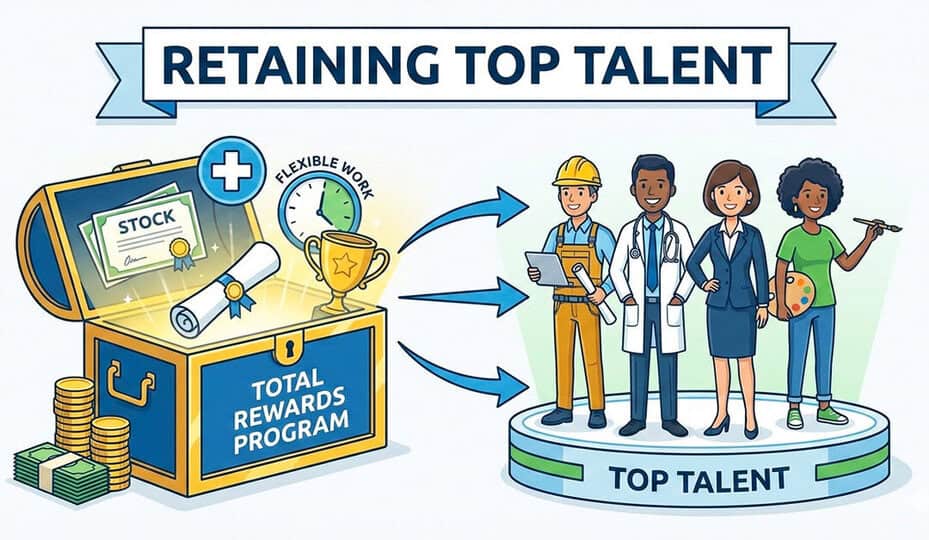
A total rewards package captures everything your organization offers, not just the number on a paycheck.
For CompLogix users, total rewards statements already hold most of the puzzle pieces. But if you’re not already on our platform, this guide shows you how to assemble them into a story employees actually believe.
Key Takeaways
Total rewards show employees value beyond salary and bonus.
CompLogix helps centralize data for accurate total rewards statements.
Communicating total rewards year-round builds trust and engagement.
Measuring outcomes reveals gaps in flexibility, development, or benefits.
What Is a Total Rewards Package?
A total rewards package is the complete value an employer provides to employees, combining compensation, benefits, work life balance, recognition, and career development into a single framework.
In essence, it moves the conversation beyond base pay to include health insurance, retirement contributions, paid time off, flexible work arrangements, learning budgets, and recognition programs.
The distinction matters. Traditional compensation discussions focus on salary and maybe a bonus. Total rewards reframes the question from “what do I earn?” to “what do I receive?” That shift changes how employees perceive their relationship with your organization.
Most modern frameworks organize total rewards into four or five pillars. SHRM’s total rewards model breaks these into:
Compensation
Benefits
Work-life effectiveness
Recognition
Development
Each pillar contributes to attraction, retention, and engagement in different ways.
Cash compensation gets people in the door.
Benefits keep them from walking out when a recruiter calls.
Recognition and development determine whether they show up engaged or just present.
For CompLogix users, the platform already tracks the compensation pillar in detail. The opportunity lies in connecting that data to the other four pillars so employees see a unified value proposition rather than isolated line items.
How Total Rewards Give Comp Pros a Competitive Edge
The math problem facing most HR teams is straightforward. You can’t win a salary war against a competitor with deeper pockets. But you can win a total rewards comparison if you articulate the value that competitors overlook.
I learned this running compensation for a mid-sized tech company competing against FAANG recruiters.
Our base pay sat 15% below market for senior engineers which meant we lost every candidate who only looked at salary. But we started presenting total rewards statements showing our 100% remote policy, unlimited learning stipend, and four-day summer weeks, our offer acceptance rate climbed from 52% to 71% in two quarters.
The compensation hadn’t changed, but the communication had.
That correlation makes sense when you consider turnover costs. Replacing an employee runs 50% to 200% of annual salary depending on the role. A clear total rewards strategy reduces the surprises that drive regrettable attrition.
CompLogix users have an advantage here. The platform centralizes salary bands, merit matrices, and bonus structures in one place. That foundation makes it far easier to layer in benefits valuations and generate the total rewards statements that shift employee perception.
Core Components of a Modern Total Rewards Package
The pillars of total rewards stay consistent across organizations, but the elements within each pillar vary based on workforce demographics, industry norms, and budget constraints.
1. Cash Compensation
Cash compensation includes base salary, variable pay, bonuses, commissions, and equity grants.
This is CompLogix territory. The platform tracks salary ranges, compa ratios, and merit budgets that form the backbone of your compensation pillar.
Most organizations target a market percentile (50th, 60th, or 75th) for cash compensation, then differentiate on other pillars.
2. Benefits
Benefits cover health, dental, and vision insurance alongside retirement plans, life insurance, disability coverage, and supplemental programs.
The employer cost of benefits often reaches 20% or more of base salary, yet employees routinely underestimate this value.
One NFP study found that 50% of employees have $1,000 or less saved for emergencies. This explains why financial wellness benefits like emergency savings programs and earned wage access are becoming standard total rewards components.
3. Work Life and Flexibility
Work-life balance and flexibility encompass paid time off, remote work policies, flexible scheduling, parental leave, and sabbatical programs.
These elements carry minimal direct cost but significant perceived value, particularly for employees balancing caregiving responsibilities.
4. Recognition
Recognition includes formal programs like spot bonuses and service awards alongside informal acknowledgment practices.
This area covers training budgets, tuition reimbursement, mentorship programs, promotion pathways, and stretch assignments.
HR leaders in the field consistently report that employees who see clear growth trajectories stay longer, even when offered higher salaries elsewhere.
How CompLogix Fits Into Your Total Rewards Strategy
CompLogix functions as the compensation engine of your total rewards ecosystem. The platform already manages the data you need to build credible total rewards statements. The question is how to extend that data into a broader narrative.
Start by exporting your salary and bonus data at the employee level. CompLogix stores current salaries, target bonuses, and equity values (if applicable) in structured formats. That export becomes the foundation of a total rewards statement template.
Next, layer in benefits costs. Most benefits administrators can provide per employee or per plan tier costs for health insurance, retirement match, and ancillary coverages. If you use a benefits administration platform, look for integration capabilities or manual export options. The goal is a single row per employee showing cash compensation plus employer paid benefits.
Then add the elements that are harder to quantify. Assign a dollar value to paid time off by calculating daily rate multiplied by PTO days. Estimate the value of remote work flexibility using commute cost savings or local market rent differentials. Some organizations skip dollar values for these items and simply list them as included benefits, which still improves perception even without specific numbers.
The final step is presentation. A total rewards statement should lead with total compensation value before breaking down components. I have seen statements that bury the headline number below three paragraphs of corporate messaging. Employees skip to the number anyway, so put it at the top.
Communicating Total Rewards to Employees and Managers
A total rewards strategy only works if employees understand it. That sounds obvious, but most organizations fail here.
The common mistake is treating total rewards statements as a once-a-year document that arrives during open enrollment and disappears into an inbox.
Employees glance at the number, compare it to last year, and move on. No lasting perception shift happens because the statement lacks context.
Philosophy comes first. Why does your organization invest heavily in development budgets but sit at the 50th percentile for base pay? Employees accept tradeoffs they understand. They resent tradeoffs they discover by accident.
Managers carry the message from there. The supervisor who can say “your base increase is 3%, and we’re also adding $2,500 to your learning budget based on your development goals” creates a different experience than the one who says “you’re getting 3%.”
CompLogix users can support this by generating manager-facing reports that show total compensation by team member, giving supervisors the data they need before those conversations happen.
Finally, make statements accessible year-round rather than burying them in open enrollment emails. Some organizations publish total rewards portals.
Others integrate summaries into HRIS self-service dashboards. The format matters less than the availability.
How to Measure Total Rewards Effectiveness
A total rewards program without measurement is just a collection of benefits. The question isn’t whether you offer enough, but rather whether what you offer actually moves retention, engagement, and hiring outcomes.
Start with offer acceptance rate. If acceptance declines while your compensation stays at market, the gap likely sits in benefits perception or flexibility rather than pay. Voluntary turnover by segment tells a similar story.
High turnover among mid-career professionals often signals weak development pathways. High turnover among working parents usually points to flexibility gaps.
Engagement surveys add direct feedback, but look for year-over-year trends rather than absolute scores. A 72% favorability rating on compensation means little in isolation. A 10-point drop from last year means everything.
Benefits utilization reveals whether employees actually use what you offer. Low uptake on a learning stipend suggests poor communication or misaligned offerings. Either way, you’re paying for value that isn’t landing.
CompLogix users can connect these dots by exporting salary and compa ratio data, then joining it to HRIS or survey data in a BI tool. The analysis often surfaces what pure compensation reviews miss: high performers leaving despite above-market pay because they see no promotion path.
Frequently Asked Questions
Why should HR teams focus on total rewards instead of just salary?
Total rewards reflect the full value of working for your organization, helping you compete for talent, reduce turnover, and align investments with what different employee segments value most.
How do I start building a total rewards package?
Begin by auditing what you already offer, clarifying your pay and benefits philosophy, segmenting your workforce, quantifying what you can, and then designing a simple, one-page total rewards statement you can iterate over time.
How often should we review our total rewards strategy?
At minimum, review it annually alongside your compensation cycle, and more frequently if market conditions, workforce expectations, or your business strategy shift significantly.
Final Thoughts
Total rewards turns compensation into a conversation about commitment, not just numbers. When employees recognize what their organization actually invests in them, they weigh outside offers against more than a competing salary figure.
For CompLogix users, the foundation already exists. Your compensation data is structured, auditable, and ready to serve as the backbone of a total rewards strategy. The next step is connecting that data to benefits, flexibility, recognition, and development so employees see the complete picture.
Start by building one total rewards statement for a single employee segment and then test it with managers, gather feedback, and refine before scaling.
The organizations that communicate total rewards effectively do not just retain employees. They build the kind of trust that turns retention into advocacy.
Your compensation data tells one story, but your employees hear another.
I learned this the hard way during an exit interview with a senior engineer who left for a “better offer.” When I pulled his total rewards statement, the math told a different story: our package was actually $18,000 higher when you factored in benefits, equity vesting, and professional development stipends.
He had no idea and neither did his manager. That gap between what we paid and what employees perceived cost us a top performer.
A total rewards program bridges that gap. Here’s how to build one that works alongside your CompLogix compensation data.
Key Takeaways
A total rewards program includes pay, benefits, development, and recognition.
Total rewards statements help employees understand full compensation value.
Personalizing rewards improves engagement and retention across employee groups.
CompLogix data anchors your total rewards strategy and communication.
What Is a Total Rewards Program?
A total rewards program is a strategic framework that combines compensation, benefits, well being support, career development, and recognition into a unified employee value proposition. It extends far beyond base salary and bonus structures to capture every way your organization invests in its people.
Total compensation covers only the financial elements: base pay, incentives, equity, and cash bonuses. Total rewards adds the non monetary investments that often represent 30% or more of what employers actually spend on each employee.
WorldatWork, the leading compensation and rewards association, defines five core elements in their total rewards model:
compensation
benefits
well-being
development
recognition
If you’re already running compensation cycles through CompLogix, you have a strong foundation in the first element. The challenge is connecting that foundation to the other four in a way employees actually understand.
Most compensation professionals I talk with manage salary ranges, merit increases, and bonus pools with precision. They can tell you exactly where an employee sits within their band and how that compares to market data.
What they struggle to articulate is how that salary fits into the broader picture of what the organization provides.
Why Total Rewards Matter for Compensation Professionals
Organizations with clearly articulated total rewards strategies see measurable improvements in retention, engagement, and perceived pay fairness. And the business case is straightforward.
Research from Trusaic shows that organizations prioritizing pay equity and transparency are 1.6 times more likely to meet or exceed financial targets. A 2024 analysis of total rewards programs found that organizations implementing customized reward systems achieved up to a 25% improvement in retention rates.
Those numbers align with what I’ve seen in practice. When employees understand the full value of their package, the “I can get paid more elsewhere” conversation changes. Sometimes they’re right, and you need to address a real market gap.
Often, though, they’re comparing base salary to base salary without accounting for the retirement match, the wellness stipend, or the tuition reimbursement they’ve been using for two years.
The perception gap becomes real when you think about it. Many in HR consistently report that employees underestimate the value of their benefits and recognition awards until they see a consolidated total rewards statement.
One compensation manager described using these statements during stay conversations and watching the dynamic shift when an employee realized their “lower salary” came with $22,000 in additional value they had mentally discounted to zero.
The Five Components and Where CompLogix Fits
Understanding how your compensation management platform connects to broader total rewards helps you build a more coherent strategy.
Compensation forms the foundation. This includes base salary, variable pay, bonuses, etc…
If you’re using CompLogix, this is your home territory. Your salary structures, merit matrices, and bonus calculations live here. The data you manage becomes the anchor point for total rewards statements and employee communications.
Benefits cover health insurance, retirement plans, paid time off, and supplemental programs like life insurance or disability coverage.
According to SHRM research, 63% of surveyed employers now offer student loan repayment benefits, a category that barely existed five years ago.
Benefits data typically lives in your HRIS or benefits administration platform, but it needs to connect to your compensation story.
Well-being encompasses physical, mental, and financial wellness programs. This might include gym subsidies, employee assistance programs, financial coaching, or mental health resources.
These programs often fly under the radar in employee communications despite representing meaningful organizational investment.
Development includes training, tuition assistance, career pathing, mentorship programs, and internal mobility opportunities.
When an employee asks about their growth potential, the answer should include both compensation progression (which you can model in CompLogix) and the development resources that accelerate that progression.
Recognition covers both formal programs (service awards, spot bonuses, peer recognition platforms) and informal acknowledgment practices.
Recognition programs that tie back to compensation data create reinforcing loops where achievement connects to reward.
The integration challenge is real. Most organizations manage these five elements across separate systems with separate owners.
Benefits sits with a broker relationship. Well-being programs scatter across vendor contracts. Recognition might live in a standalone platform or in manager discretion with no tracking at all.
Your compensation data in CompLogix can serve as the connective tissue. When you build total rewards statements or have compensation conversations, you’re pulling threads from all five areas into a coherent narrative.
Building a Total Rewards Strategy Around Your Compensation Data
If you already have compensation management dialed in, extending to total rewards is more evolution than revolution. The process starts with inventory and ends with communication.
1. Start with what you have
Export your current salary structures, bonus targets, and equity schedules from CompLogix. List every benefit, program, and perk your organization offers across the other four categories.
You’ll likely discover programs that exist but have never been communicated effectively, or that managers do not know how to explain.
2. Assign dollar values where possible
Employer contributions to health insurance, retirement matches, tuition reimbursement caps, and wellness stipends all have concrete numbers. Professional development budgets, even if underutilized, represent real organizational investment.
The goal is to move from “we offer good benefits” to “we invest an additional $28,000 per employee beyond base salary.”
3. Identify your differentiators
Every organization offers health insurance and a 401(k). What makes your package distinct?
Maybe its:
an unusually generous parental leave policy
a sabbatical program after five years
a professional development budget that employees control directly
These differentiators should feature prominently in recruiting conversations and retention discussions.
4. Segment where it matters
One insight from recent total rewards research is that personalization drives impact. A 25 year-old software engineer and a 55 year old finance director value different components of the same package.
The engineer might prioritize student loan assistance and career development, while the director might care more about retirement contributions and healthcare coverage.
Your total rewards communication can acknowledge these differences without creating entirely separate programs.
5. Connect to your compensation philosophy
If CompLogix holds your pay philosophy documentation, your total rewards strategy should extend that philosophy.
An organization that emphasizes pay for performance should have recognition and development programs that reinforce that emphasis.
An organization that leads on benefits can position that leadership as deliberate strategy rather than happy accident.
The best total rewards strategy fails if employees don’t understand it. Communication is where most programs fall short.
1. Total rewards statements work
These documents consolidate every element of an employee’s package into a single view:
base salary
bonus target
employer benefit contributions
program availability
… and more.
The format forces clarity. If you can’t explain it simply on one page, employees certainly can’t understand it across twelve different systems.
Generating these statements requires pulling data from multiple sources. Your CompLogix compensation data provides the anchor.
Benefits administration provides contribution amounts and recognition platforms provide program participation. The assembly can be manual for smaller organizations or automated through HRIS integrations for larger ones.
2. Train your managers
Compensation professionals consistently identify manager understanding as a bottleneck. Your total rewards program might be comprehensive and competitive, but if managers can’t explain it during offer conversations or performance reviews, employees experience confusion rather than appreciation.
One manager I know described it bluntly: “Without manager training, even well-designed programs are just a PDF on the intranet.”
I always suggest building simple talking points or running calibration sessions before review cycles. Give managers the language to answer “why this number?” with more than salary band placement.
3. Time your communication strategically
Total rewards statements during annual enrollment remind employees of benefit value right when they’re making elections.
Statements during performance reviews connect compensation decisions to the broader package. On the other hand, statements during retention conversations give managers concrete data to work with.
4. Address the perception gap directly
If your analysis shows that employees undervalue specific components, call that out. “Your employer healthcare contribution is $14,400 annually, which is 40% higher than the regional average” lands differently than “we offer competitive benefits.”
Making It Work in Practice
Total rewards isn’t a one time project. It requires ongoing attention as programs evolve and workforce expectations shift.
Start by reviewing your total rewards inventory annually.
Benefits change, new programs launch, and old programs sunset, so your documentation should always stay current. Where possible, track utilization data to spot opportunities for improvement.
Professional development budgets that go unused, wellness programs with low participation, and recognition platforms that only managers access all signal a need to either improve communication or reallocate investment.
Employee feedback is equally important.
Survey data, exit interviews, and stay conversations reveal what employees actually value versus what you assume they value, and that insight should influence both program design and communication emphasis.
Finally, connect total rewards to business outcomes.
Retention rates, offer acceptance rates, and engagement scores all relate to how employees perceive their total package. Building those connections helps justify continued investment and positions compensation professionals as strategic partners rather than administrative functions.
Final Thoughts
A total rewards program transforms how employees understand their relationship with your organization. It moves the conversation from “what is my salary?” to “what is my total investment here?” That shift changes retention conversations, recruiting pitches, and day to day engagement.
If you’re already managing compensation through CompLogix, you have the foundation. Base pay, incentives, bonus structures, and equity data give you the anchor point. The work now is connecting that anchor to benefits, well being, development, and recognition in a way that employees can see and managers can explain.
Start this week by inventorying what your organization actually provides beyond the paycheck. Assign dollar values where you can. Identify the gaps in communication that let employees undervalue what you offer.
The engineer who left for a “better offer” taught me that perception shapes reality. Your total rewards data might show a competitive package. What matters is whether your people know it.
Your top performer just handed in her resignation. During the exit interview, she mentioned a competitor offered $8,000 more in base salary.
What she didn’t realize: her current total compensation, including employer health contributions, retirement matching, and professional development benefits, exceeded that offer by nearly $15,000.
I’ve watched this scenario play out more times than I can count. The problem is rarely compensation itself. The problem is that employees can’t see the full picture because nobody showed it to them.
A well-designed total rewards statement template fixes that gap by translating every dollar your organization invests in an employee into a single, readable document.
This guide walks through exactly how to build one, what to include, and how to roll it out without burying your HR team in spreadsheet chaos.
What a Total Rewards Statement Actually Does
A total rewards statement is a personalized document that shows employees the complete value of their compensation package, combining salary, benefits, and non-monetary rewards into one clear view. It answers the question every employee quietly asks: “What am I really getting paid?”
Most employees see only their base salary. They forget about things like the:
$18,000 their employer contributes annually toward health insurance
4% retirement match
$2,500 professional development stipend sitting unused in their benefits portal.
A total rewards statement surfaces all of it.
The business case is straightforward. According to AIHR’s 2024 research on total rewards, improved benefits communication can increase employees’ sense of being cared for by 50%. Employees who feel cared for are 1.3 times more engaged and loyal, and 1.2 times more productive.
Those numbers compound quickly across a workforce of any size.
The Four Building Blocks of a Strong Template
Every effective total rewards statement template organizes information into four distinct categories. This framework, drawn from compensation best practices, gives employees a logical way to understand where their value comes from.
1. Financial Rewards
Financial rewards cover the cash components: base salary, bonuses, and any variable pay. This section answers the “what hits my bank account” question and typically anchors the top of the statement.
2. Monetary Benefits
Monetary benefits include employer-paid contributions that employees often undervalue. Health insurance premiums, retirement plan matches, life insurance, and disability coverage fall here.
I once worked with a manufacturing company where employees had no idea the employer paid $22,000 annually toward family health coverage. Adding that single line to their statements changed how three retention-risk employees viewed their offers from competitors.
3. Non-Financial Rewards
Non-financial rewards capture the tangible perks that carry real dollar value: professional development stipends, wellness programs, tuition reimbursement, commuter benefits, and paid time off. These items have quantifiable worth even if they do not appear on a paycheck.
4. Intangible Rewards
Intangible rewards are harder to monetize but still matter: flexible work arrangements, career development opportunities, recognition programs, and company culture.
Some organizations include these as a qualitative section; others leave them out to keep the statement focused on numbers.
Choosing the Right Data to Feed Your Template
The strength of any total rewards statement depends entirely on the accuracy of the data behind it. Garbage in, garbage out applies here more than anywhere else in HR.
Start by mapping your data sources. Most organizations pull from at least four systems:
Data Type
Typical Source
Update Frequency
Base salary and job level
HRIS (Workday, ADP, BambooHR)
Per pay cycle
Bonus and commission
Payroll or incentive management
Quarterly or annual
Benefits elections
Benefits administration platform
Annual enrollment
PTO and leave balances
HRIS or time tracking system
Per pay cycle
The most common mistake I see is pulling data from secondary reports instead of source systems. A manager’s spreadsheet might say an employee earns $95,000, but payroll shows $92,500 because someone forgot to update the tracker after a mid-year adjustment.
Always pull from the authoritative system for each data type, and document which system that is.
For benefits, decide whether you are showing employer contribution only or total premium value. Showing employer contribution is more defensible and avoids confusing employees who know their own paycheck deductions.
Layout Patterns That Make Statements Readable
Template design matters more than most HR teams realize. A dense wall of numbers overwhelms employees and defeats the purpose of transparency.
The most effective layouts I have seen follow one of three patterns
The first is a tiered summary approach: lead with total compensation as a single headline number, then break it down by category, then by line item. This lets executives scan the top line while detail-oriented employees can dig deeper.
The second pattern uses visual proportions. A simple pie chart showing salary versus benefits versus bonuses helps employees grasp relative value at a glance.
One retail HR director told me her employees finally understood why the company could not match a competitor’s base salary offer once they saw that benefits represented 38% of their total package.
The third pattern is timeline-based, showing how compensation has grown year over year. This works well for retention conversations and annual reviews, though it requires maintaining historical data.
Whichever layout you choose, keep explanatory text minimal. Each category should include one sentence explaining what it covers, not three paragraphs of legalese. White space is your friend.
How to Build a Total Rewards Statement Template
Creating a total rewards statement template from scratch involves five phases. The timeline varies based on organizational complexity, but expect 6 to 12 weeks for a first rollout.
Phase 1: Discovery and Scope (1 to 2 weeks)
Inventory every data source and decide what to include. Define your audience segments. A template for hourly warehouse workers will look different from one for salaried managers with complex bonus structures. Align with finance and legal on what numbers you can disclose.
Phase 2: Data Integration (1 to 2 weeks)
Map HRIS fields to template fields. Build or configure data pipelines. This phase takes longer than anyone expects because it surfaces data quality issues you did not know existed. Budget extra time for cleanup.
Phase 3: Template Design (2 to 3 weeks)
Configure layouts, branding, and explanatory text. If you are using compensation software, this is where you build out the template modules. If you are doing this manually, create your Excel or Google Sheets template with formulas and conditional formatting.
Phase 4: Pilot (1 to 2 weeks)
Test with a small group, ideally 20 to 50 employees across different job families. Collect feedback on clarity, accuracy, and perceived value. Fix errors before they scale.
Phase 5: Rollout (2 to 4 weeks)
Launch to the full organization, ideally timed with annual merit increases or open enrollment when employees are already thinking about compensation.
Rolling Out Without Overwhelming Your Team
The operational burden of total rewards statements depends almost entirely on how you generate them. Manual approaches using spreadsheet mail merges work for organizations under 100 employees, but they break down quickly as headcount grows.
The breaking point usually arrives when HR spends more than 40 hours per cycle generating and distributing statements. At that point, the cost of manual effort exceeds the cost of software that automates the process.
Three signals indicate you have outgrown spreadsheets:
you’re copying and pasting data between systems
you have caught errors in distributed statements more than once
Compensation platforms like CompLogix include total rewards statement modules that pull data directly from connected HRIS and benefits systems.
The value isn’tjust time savings, but also version control, audit trails, and the ability to regenerate statements on demand when employees ask questions.
Measuring Whether Your Template Works
Launching a total rewards statement isn’t the finish line. You need to know whether employees actually understand and value what they receive. I suggest tracking three categories of metrics.
1. Access Metrics
Access metrics tell you whether employees engage with the statement at all: open rates for emailed PDFs, login rates for online portals, and time spent viewing. If 60% of employees never open their statement, you have a distribution or awareness problem.
2. Comprehension Metics
Comprehension metrics require surveys. Ask employees whether they can name three benefits their employer provides and estimate the dollar value. Run this survey before and after your first statement rollout to measure lift.
3. Outcome Metrics
Outcome metrics connect statements to business results. Monitor retention rates among employees who engaged with their statements versus those who didn’t. Track whether candidates mention total rewards during offer negotiations.
One tech company I worked with found that candidates who received total rewards statements during the offer stage accepted 23% more often than those who saw only base salary.
Automating Statements with CompLogix
For organizations ready to move beyond spreadsheets, CompLogix’s Total Rewards Statements module connects directly to your existing HRIS and benefits systems.
The platform pulls compensation data automatically, applies your configured templates, and generates personalized statements that employees can access online or download as PDFs.
The configuration process mirrors the phases outlined above, but with less manual data wrangling. Templates are brandable and support multiple layouts for different employee segments.
Integration with CompLogix’s broader compensation management suite means merit increases flow directly into updated statements without re-importing data.
If you are evaluating options, start by documenting your current process: how many hours it takes, how many systems you touch, and how often errors occur. That baseline helps you calculate ROI and build a business case for leadership.
Final Thoughts
A total rewards statement template does one thing well: it shows employees the full value of working for you. That visibility reduces the risk of losing talent to offers that look better on paper but are not.
It gives managers a tool for retention conversations. And it forces your organization to quantify investments you are already making.
Start small. Pick one employee segment, build a template using the four-category framework, and pilot it with a test group. Gather feedback, fix what confuses people, and expand from there.
The organizations that get this right do not treat total rewards statements as an annual compliance exercise. They treat them as an ongoing conversation about value.
Your top performer just turned in their resignation letter. When you asked why, they said a competitor offered “better pay.”
The frustrating part? Their total compensation package was actually $18,000 higher than the new offer once you factored in benefits and retirement matching. They just never saw the full picture.
I watched this exact scenario unfold at a mid-sized manufacturing company three years ago. The HR director spent two hours pulling data from six different systems to prove the point, but by then the employee had already mentally checked out.
A total rewards statement would have made that value visible from day one.
If you’re already using CompLogix for compensation management, you have the foundation to build statements that prevent these costly misunderstandings. If not, this guide walks through exactly how to turn your compensation data into a communication tool that drives retention and trust.
Key Takeaways
Total rewards statements show full compensation beyond base pay.
Employees often undervalue benefits without clear dollar translation.
CompLogix centralizes data needed for accurate, trusted statements.
Clear statements reduce turnover and strengthen compensation trust.
What Is a Total Rewards Statement?
A total rewards statement is a personalized document that shows employees the complete monetary value of their employment relationship, including base salary, variable pay, benefits, retirement contributions, and perks.
The typical statement includes, direct compensation (salary and bonuses), health and welfare benefits with employer contribution amounts, retirement plan matching, paid time off value, or long-term incentives, and any additional perks like tuition reimbursement or wellness stipends.
Think of it as the difference between showing someone their grocery receipt versus showing them all the meals those groceries will create. The receipt is accurate but incomplete. The total rewards statement tells the whole story.
Why CompLogix Users Have an Advantage
Most HR teams struggle with total rewards statements because their compensation data lives in disconnected systems.
Salary information sits in one platform, benefits in another, and bonus calculations in a spreadsheet someone created four years ago. Pulling everything together becomes a quarterly project instead of an automated process.
CompLogix users skip that headache. Your compensation management platform already centralizes the salary structures, pay ranges, merit increase history, and bonus calculations that form the backbone of any rewards statement.
The data architecture exists. The question is whether you’re using it for communication or just for administration.
I helped a 400-person professional services firm connect their CompLogix data to a statement generation workflow last year.
Their previous process took the compensation team three weeks to produce annual statements. After building the integration, they cut that to four days and gained the ability to generate on-demand statements whenever a manager needed one for a retention conversation.
The efficiency gain matters, but the strategic value matters more. When compensation data flows directly into employee communication, you eliminate the transcription errors and version-control problems that undermine trust.
The numbers employees see match the number in the system of record.
What Belongs in Your Statement
Effective total rewards statements balance comprehensiveness with clarity. Include too little and employees miss the point, but too much and they stop reading after the first page.
Start with direct compensation, the components employees already know.
Think of base salary, any shift differentials or location premiums, and variable pay like bonuses. This section builds credibility because employees can verify these numbers against their own records.
Next comes employer-paid benefits, the category where most employees dramatically underestimate value.
Break out the employer contribution to health insurance premiums (not the total premium, just what the company pays), dental and vision contributions, life insurance, disability coverage, and any HSA or FSA matching.
Retirement contributions deserve their own prominent section.
I suggest showing the employer match amount, any profit-sharing contributions, and things of that nature. For employees mid-career, this section often represents tens of thousands in annual value they mentally discount to zero because they simply because they can’t spend it today.
Paid time off should appear as a dollar figure, not just a day count. Calculate the value by multiplying days by the employee’s daily rate. A statement that says “15 PTO days” feels different than one that says “15 PTO days valued at $4,800.”
Finally, include any additional perks with quantifiable value. Things like:
tuition reimbursement used
wellness program subsidies
parking or transit benefits
employee discounts
any similar items
Even small amounts reinforce the message that the organization invests in employees beyond the paycheck.
How to Build Statements From Your CompLogix Data
The technical process starts with identifying which data fields in CompLogix map to each statement section:
Base salary and pay grade information export cleanly:
Merit increase percentages and effective dates give you the story of how compensation has grown.
Bonus targets and actual payouts round out the direct compensation picture.
For CompLogix users running compensation cycles through the platform, you already have historical data that makes trend visualization possible. Consider including a simple chart showing total compensation growth over the past three years. That visual context helps employees see their trajectory rather than just a snapshot.
The challenge comes when you need data that lives outside CompLogix.
Benefits administration systems, retirement plan recordkeepers, and equity management platforms each hold pieces of the puzzle. The integration approach depends on your technical resources, but even a manual annual data pull beats having no statement at all.
All of your external benefits can be imported into CompLogix so that all total rewards data is in one system which can produce high quality Total Rewards Statements.
Common Mistakes That Undermine Your Statements
The most frequent error I see is timing statements to coincide with open enrollment rather than compensation cycles.
Open enrollment already overwhelms employees with decisions. Layering a total rewards statement on top means it gets skimmed rather than studied.
Instead, try sending statements after merit increases take effect, when employees are paying attention to their compensation and have fresh context for the numbers. CompLogix makes it easy with its self-service option, allowing employees to easily access their statement from within CompLogix.
Secondly, jargon kills comprehension. Terms like “employer FICA contribution” or “imputed income on GTL” mean nothing to most employees.
Try translating every line item into plain language, even if it requires a parenthetical explanation. For example, “Social Security taxes the company pays on your behalf” works better than acronyms.
Failing to train managers also creates a secondary problem.
Employees often bring their statements to their supervisor with questions. If the manager can’t explain what “compa-ratio” means or why the benefits value changed from last year, the statement raises more questions than it answers.
Building a brief FAQ document and walking managers through it before statements go out is a great way to get in front of these types of problems before they arise.
Getting Employees to Actually Read the Statement
Getting employees to actually read a total rewards statement comes down to how it shows up in their world.
A PDF attached to an HR email is easy to ignore, while a statement reviewed in a one on one or self-retrieved from a system like CompLogix is more likely to be read and discussed. The format should reflect how your workforce already consumes information, whether that means an interactive portal experience or a clear, well-designed printed document.
The framing of the message matters just as much as the format. Language that sounds like justification or persuasion tends to trigger skepticism.
A statement works better when it is positioned as a transparency tool that helps employees understand how their compensation is structured and funded, not as an argument that they should feel satisfied.
A small amount of follow-up reinforces that intent. A brief reminder or an optional Q&A session signals that the organization expects employees to engage with the statement and ask questions, rather than treating it as another document to skim and forget.
Making Statements Part of Your Compensation Strategy
Total rewards statements work best when they connect to broader compensation communication rather than standing alone.
Reference the statement during performance reviews when discussing merit increases.
Mention it during recruiting when candidates ask about benefits.
Use it as a retention tool when employees signal they are exploring other opportunities.
The data from Flimp’s research on workforce loyalty suggests personalized statements drive engagement precisely because they make abstract policies concrete. Employees stop thinking of benefits as a checkbox on a job listing and start thinking of them as real financial value.
For CompLogix users specifically, the statement becomes an extension of your compensation philosophy documentation. If your philosophy emphasizes market competitiveness, the statement proves it with benchmarking context. If your philosophy prioritizes internal equity, the statement can show how the employee’s compensation relates to their pay band.
The investment required is modest compared to the cost of preventable turnover. Replacing an employee costs 50% to 200% of their annual salary, depending on the role. A total rewards statement that prevents even one regrettable departure pays for itself many times over.
Your CFO asks about “total compensation costs” while your CHRO wants to discuss “total rewards strategy.” Are they talking about the same thing?
I’ve watched HR teams conflate these two terms for years, and the confusion creates real problems.
Managers quote total compensation figures during retention conversations when employees actually care about the broader experience. Finance pulls reports expecting one set of numbers and gets another.
The disconnect frustrates everyone.
This guide breaks down exactly how total rewards differs from total compensation, why the distinction matters for your talent strategy, and how to communicate both concepts clearly to stakeholders across your organization.
Key Takeaways
Total compensation covers all financial pay and employer-paid benefits.
Total rewards includes compensation plus culture, growth, and flexibility.
Misusing these terms creates confusion across HR, finance, and leadership.
What Is Total Compensation?
Total compensation is the complete sum of all financial rewards an employee receives from their employer, including base salary, bonuses, equity, and the monetary value of benefits.
It represents a transaction: the quantifiable value exchanged for an employee’s time, skills, and contributions.
Think of total compensation as everything you could put a dollar sign in front of. Your compensation management software tracks these numbers. When you run a pay analysis or generate employee statements, you’re working with total compensation data.
The typical components include:
Base salary (the fixed amount paid on a regular schedule)
Variable pay such as bonuses, commissions, and incentive payouts
Employer contributions to health insurance, retirement plans, and other benefits
Paid time off calculated at its monetary equivalent
According to the Bureau of Labor Statistics, benefits account for roughly 31% of total employer compensation costs in the private sector, with direct wages making up the remaining 69%. That split explains why employees often underestimate their true compensation when they only focus on their paycheck.
When I audit compensation data for clients, the benefits load typically surprises managers who assumed their $75,000 employee actually costs $75,000. The real number usually lands closer to $100,000 once you factor in health premiums, 401(k) matching, payroll taxes, and other employer paid costs.
What Are Total Rewards?
Total rewards is a broader strategic framework that includes total compensation but extends into non-financial elements like career development, work environment, recognition, and work-life balance. It captures everything an organization offers to attract, motivate, and retain employees.
Think of total compensation as a subset sitting inside total rewards. While total compensation answers “what do we pay this person,” total rewards answers “what is the complete value proposition of working here.”
Benefits (health, retirement, and legally required programs)
Work-life balance (flexible schedules, remote options, and paid time off policies)
Performance and recognition (feedback systems, awards, and acknowledgment programs)
Development and career opportunities (training, mentorship, and advancement paths)
Your compensation software excels at managing the first two pillars. But it was never designed to quantify the full total rewards picture, and that’s intentional. Some elements of total rewards resist clean numerical measurement.
How do you assign a dollar value to a supportive manager? What’s the ROI on flexible Fridays? These questions matter for employee engagement, but they don’t fit neatly into compensation planning cycles.
A Side-by-Side Comparison
The clearest way to understand these concepts is seeing them together. Here’s how they differ across several dimensions:
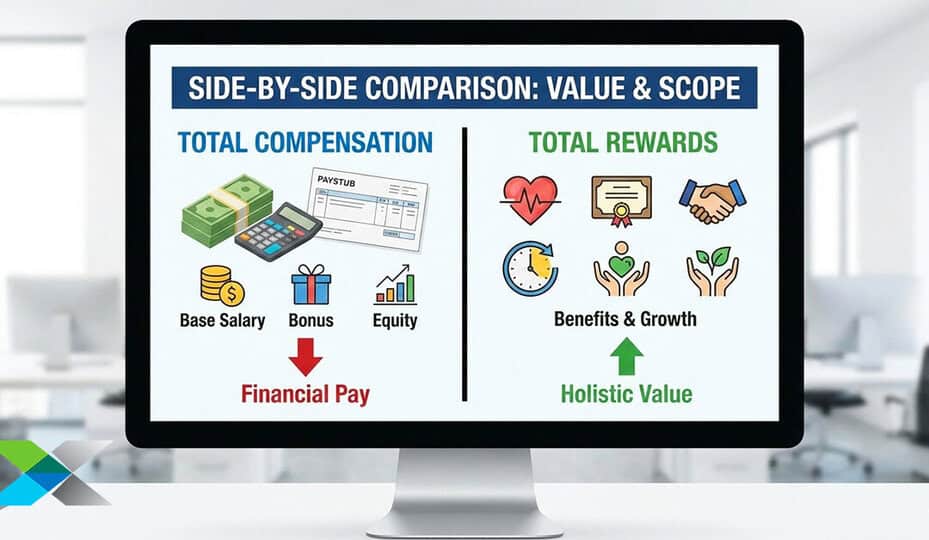
Scope: Total compensation covers financial rewards only. Total rewards encompasses the entire employee experience, including culture, development, and work environment.
Measurability: Total compensation translates directly into dollars. Total rewards includes elements that are difficult or impossible to quantify accurately.
Primary use case: Total compensation drives budgeting, benchmarking, and pay equity analysis. Total rewards shapes employer branding, engagement strategy, and retention efforts.
Communication timing: Total compensation typically appears in annual statements or offer letters. Total rewards messaging happens continuously through onboarding, manager conversations, and employee communications.
Ownership: Total compensation usually sits with the compensation team or finance. Total rewards requires collaboration across HR, learning and development, employee experience, and leadership.
Why the Distinction Matters
I learned this lesson the hard way during a retention conversation that went sideways.
A high performer wanted to leave for a competitor offering $15,000 more in base salary. My manager pulled up our total compensation statement showing the employee actually earned $12,000 more than that competitor once you factored in our superior benefits package.
The employee didn’t care. She wanted remote work flexibility, clearer promotion paths, and more autonomy. Those factors weren’t on any statement we could generate, and no amount of benefit math was going to change her priorities.
That’s the gap between total compensation and total rewards in action. The numbers said we were winning, but the employee’s experience said otherwise.
This pattern repeats across HR functions. Pay surveys tell you whether compensation is competitive, but two companies can offer identical total compensation while delivering vastly different employee experiences. Exit interviews cite “lack of growth opportunities” while your data shows above-market pay.
Candidates weigh factors beyond the numbers, with Gallup research showing development opportunities rank among the top factors younger workers consider when choosing employers.
The common thread: total compensation data answers important questions, but not every question that matters.
When Total Compensation Falls Short
There are specific situations where leaning too heavily on total compensation data leads you astray.
Situation
Why Compensation Data Fails
What Actually Works
Competing with higher offers
A benefits breakdown won’t close a $20K salary gap
Culture, mission, flexibility, growth paths
Addressing engagement issues
Itemized statements don’t fix feeling undervalued
Investigating management quality and recognition
Explaining pay compression
Numbers can’t make unfairness feel fair
Narratives about tenure benefits like flexibility
Recruiting in tight markets
You can’t always win on salary
Remote policies, learning stipends, meaningful work
The pattern across all four is that compensation data describes what you pay, but total rewards thinking addresses why someone would want to work for you anyway.
The Practical Limits of Quantifying Total Rewards
Some HR teams attempt to assign dollar values to every total rewards element, calculating the “value” of flexible work at $5,000 per year or estimating development programs worth $3,000 annually.
I understand the impulse, but this approach creates more problems than it solves.
Employees see through inflated statements. When you tell someone their flexibility is “worth” $5,000, they know that number is arbitrary. Worse, it can feel manipulative, like you’re trying to paper over inadequate compensation with accounting tricks.
One employee might value remote work enormously while another prefers coming into the office. Assigning the same dollar amount to both ignores the individual nature of what makes work rewarding.
I suggest keeping your compensation outputs clean and financially accurate. Save the total rewards conversation for qualitative discussions where you’re genuinely listening to what employees value.
Total rewards communications encourage employees to view their value proposition as an ongoing investment rather than a single snapshot, a perspective shift that can improve retention even when compensation budgets are tight.
Using Both Concepts Effectively
The most effective compensation professionals use precise compensation analysis while thinking in total rewards terms when strategy requires it.
They run accurate pay analyses, generate clean compensation statements, model budget scenarios, and benchmark against market data.
Then they step outside the numbers to consider the broader employee experience, collaborating with HR business partners on engagement data, reviewing exit interview themes, and assessing whether their total rewards proposition actually attracts and retains the talent they need.
This dual approach prevents two common errors: over-relying on compensation data to solve problems that aren’t actually about pay, and fuzzy thinking that ignores hard numbers in favor of vague “employee experience” language.
A few practical applications worth considering:
Train managers to discuss total rewards elements beyond pay. Prompts like “Beyond your salary adjustment, let’s talk about your development plan” acknowledge that pay is one piece of a larger relationship.
Create parallel employee communications. One automated statement shows dollars and cents. A separate qualitative summary covers career development resources, flexible work policies, and recognition programs.
Use exit interview data to identify which total rewards gaps compensation alone can’t fix.
Final Thoughts
Start by auditing how your organization uses these terms.
When leadership asks about “total rewards,” do they mean what your compensation system tracks or something broader?
When managers discuss “compensation,” are they including benefits or only base pay?
Establishing shared vocabulary prevents confusion and helps you communicate more effectively across functions. Finance needs precise compensation data and employees want to understand their total rewards. Your job is translating between those needs.
The numbers in your compensation data matter. They represent real value flowing to employees and real costs for your organization. Just remember they’re not the whole story, and knowing when to look beyond them is part of being an effective HR leader.
When I started my career in HR, compensation meant one thing: salary. A bonus if the year went well.
But after watching three high performers leave for competitors offering flexible schedules and better development opportunities, I realized something had shifted.
Employees now evaluate the complete picture of what an employer offers, not just the number on their paycheck. That whole picture is what we call total rewards.
This guide breaks down exactly what total rewards means, how it differs from total compensation, and how the right tools can help you design, communicate, and manage a program that actually keeps people around.
Key Takeaways
Total rewards includes all compensation, benefits, and non-cash work experiences.
Total compensation is only the financial part of the total rewards package.
Communication gaps often cause employees to undervalue their total rewards.
Compensation software connects data, builds clarity, and supports retention.
What Is Total Rewards?
Total rewards are the complete set of benefits, compensation, and experiences an employer provides in exchange for an employee’s work. It includes everything with perceived value, from base salary and bonuses to health insurance, career development, flexible scheduling, and recognition programs.
The concept frames employment as more than a financial transaction. It positions the entire relationship between employer and employee as a value exchange.
Korn Ferry’s total rewards framework describes this as “everything with perceived value” that employees receive. That phrasing matters. Perception drives retention just as much as hard dollars do.
Most contemporary frameworks organize total rewards into five core domains: compensation, benefits, work-life, recognition, and performance or development. Some models expand this to six or eight categories, separating well-being from work life or breaking out career growth as its own pillar.
The exact taxonomy matters less than the underlying principle. Your people evaluate your organization on far more than their direct deposit amount.
Total Rewards vs Total Compensation: What Is the Difference?
These terms get used interchangeably in casual conversation, but they describe different scopes. Getting the distinction right helps you communicate more clearly with executives, managers, and employees.
Total compensation refers specifically to the financial elements of an employee’s package. This includes base salary, variable pay such as bonuses, and, sometimes, the employer’s share of benefit premiums. If you put a dollar sign on it, it falls under total compensation.
Total rewards cast a broader net. It includes total compensation but adds non-monetary elements like flexible work arrangements, learning and development opportunities, recognition programs, wellness resources, and workplace culture.
Semos Cloud’s analysis frames total compensation as the financial subset, while total rewards captures the full employee value proposition.
Why does this matter? Because when you’re competing for talent, you’re rarely competing on salary alone. A candidate weighing two offers might accept a lower base at the company offering remote work flexibility, a stronger 401 (k) match, and clear promotion pathways. Total rewards give you language to articulate that broader value.
This is the foundation. Base pay, merit increases, variable compensation, and equity awards fall under this category.
Compensation strategy decisions, like whether to target the 50th or 75th percentile of market rates, directly shape your ability to attract and retain talent in competitive markets.
I’ve seen organizations obsess over compensation benchmarking while ignoring the other four domains. That approach backfires when a competitor with slightly lower salaries offers benefits or flexibility that are meaningfully better.
2. Benefits
Health insurance, retirement plans, life and disability coverage, and paid time off anchor this category.
Compport’s breakdown of total rewards components notes that benefits often represent 20 to 40 percent of an employee’s total package value, yet many employees drastically underestimate what their employer contributes.
This gap between actual value and perceived value is exactly why total rewards communication matters so much.
3. Work Life and Flexibility
Remote work options, hybrid schedules, compressed workweeks, and generous PTO policies live here.
The pandemic permanently accelerated expectations in this domain. Employees who experienced flexibility during 2020 and 2021 now treat it as a baseline expectation rather than a perk.
4. Recognition and Performance
Formal recognition programs, spot bonuses, peer-to-peer acknowledgment systems, and performance management practices shape how employees feel about their contributions. Recognition costs relatively little but drives outsized engagement returns when done consistently.
5. Development and Career Growth
Training budgets, tuition reimbursement, mentorship programs, clear promotion pathways, and stretch assignments signal that an organization invests in its people’s futures.
For high performers, especially, this domain often tips the scale when they’re evaluating whether to stay.
Why Total Rewards Matter for Today’s Workforce
Three forces have pushed total rewards from HR jargon to a strategic priority.
First, labor market dynamics shifted.
Unemployment rates in knowledge worker sectors remain low, and employees have more options than they did a decade ago. Organizations compete on the full package, not just salary.
Second, workforce expectations evolved.
Younger employees entering the workforce expect personalization. They want choice in benefits, flexibility in where and when they work, and transparency about how compensation decisions get made. A one-size-fits-all all approach no longer satisfies.
Third, total rewards are directly tied to retention and engagement.
When employees clearly understand the full value of what they receive, and when that value aligns with what they actually want, they stay longer. ExtensisHR research on total rewards programs notes that clear communication about benefits and compensation reduces turnover by helping employees feel appropriately valued.
The challenge is that most organizations struggle to communicate total rewards effectively. Benefits information lives in one system, compensation data in another, recognition programs in a third. Employees piece together fragments of their package without ever seeing the complete picture.
How Compensation Management Software Supports Total Rewards
This is where technology enters the conversation. The right compensation platform can bring your total rewards strategy to life – connecting data, surfacing insights, and making the employee experience seamless. That’s where tools like CompLogix shine.
Modeling and Planning
Compensation software handles the complex calculations behind salary structures, merit cycles, bonus allocations, and equity grants. When your total rewards strategy calls for adjusting pay mix toward more variable compensation, the platform models scenarios, tracks budgets, and ensures managers make consistent decisions.
Data Integration
A complete total rewards view requires pulling information from multiple sources:
HRIS for employee records
benefits administration systems for enrollment and cost data
recognition platforms for awards history
learning management systems for development investments
When your compensation software connects with HR and benefits systems, everything flows better, from planning to communication. Many teams use CompLogix to make that happen.
Total Rewards Statements
This is often where the total rewards strategy becomes tangible for employees. A total rewards statement aggregates compensation, benefits, and other program elements into a single, personalized document that shows what each employee receives.
Total rewards statements, like those supported by platforms such as CompLogix, help employees see the whole picture, turning invisible value into visible appreciation.
The reason is straightforward. Statements close the perception gap by showing employees the full value of their package, often revealing employer contributions to benefits and retirement that employees never see on a pay stub.
Analytics and Insights
Compensation platforms generate analytics data that helps refine total rewards strategy over time.
Which benefits do employees actually use?
How does pay competitiveness vary across departments or locations?
Where do you see higher turnover, and does compensation or benefits data suggest why?
Analysis of total rewards effectiveness through compensation software involves using engagement and retention metrics alongside compensation data to improve program design continuously.
How to Build Your Total Rewards Strategy
If you’re starting from scratch or rethinking an existing approach, here’s a practical path forward.
1. Inventory What You Already Offer
Most organizations have more total rewards elements than they realize. Map out every compensation, benefit, flexibility, recognition, and development program currently in place. Note which elements are tracked in systems and which are managed informally.
2. Define Your Philosophy
What do you want your total rewards program to communicate about your organization? Some companies lead with above-market base pay. Others compete on flexibility or development opportunities. Your philosophy guides trade-off decisions when budgets force you to choose.
3. Identify Gaps in Data and Systems
Total rewards programs run on data. If benefits cost information sits in spreadsheets while compensation lives in disconnected HRIS modules, you’ll struggle to generate accurate total rewards statements or analyze program effectiveness. Assess your current technology landscape honestly.
4. Build Communication Into the Design
A total rewards program that employees don’t understand delivers a fraction of its potential value. Plan how you’ll communicate the whole package during hiring, onboarding, annual enrollment, and performance review cycles. Total rewards statements, employee portals, and manager training all play roles here.
5. Measure and Iterate
Track engagement, retention, and employee feedback. Use your compensation platform’s analytics to identify which elements employees value most and where perception gaps remain. Total rewards strategy isn’t a one-time project. It evolves as your workforce and market conditions change.
Bringing It All Together
Total rewards represent how modern HR thinks about the employment relationship. It acknowledges that employees evaluate far more than salary when deciding where to work and whether to stay.
For HR leaders and compensation professionals, the practical challenge is execution. A total rewards strategy delivers value only when you can design competitive programs, communicate them clearly, and manage them efficiently at scale.
That is where the right software makes a difference. It helps you turn strategy into daily impact. With tools like CompLogix, your rewards program becomes clear and compelling.
The organizations winning the talent competition have moved past thinking about compensation in isolation. They’ve built total rewards programs that speak to what employees actually want, and they’ve invested in tools that make those programs visible, measurable, and sustainable.
Your total rewards story is being told whether you shape it deliberately or not. The question is whether you’re telling a compelling one.
Total rewards encompass everything employees receive in exchange for their work. For compensation professionals managing programs through CompLogix, understanding each component and how they connect is the difference between running efficient cycles and chasing data across disconnected systems.
I learned this the hard way during my first annual compensation cycle. We had base pay in one system, bonus targets in spreadsheets, and equity data locked in a separate platform nobody could access.
The total rewards statements we produced were three weeks late and riddled with errors. Once we mapped every component into a unified data model, those same statements took two days.
This guide breaks down the core compensation components of total rewards, explains how they function within modern compensation software, and shows you how to structure them for cleaner administration.
Key Takeaways
Total rewards includes compensation, benefits, development, wellbeing, and recognition.
CompLogix handles only monetary components like base pay, bonuses, and equity.
Integration accuracy is critical for bonus payouts, equity values, and allowances.
A mapped, unified rewards model streamlines cycles and prevents data errors.
Total rewards is the broader framework that includes everything an employer offers: compensation, benefits, wellbeing programs, career development, and recognition.
Total compensation narrows the focus to monetary value, specifically base pay plus incentive pay plus the cash value of benefits.
AIHR’s total rewards strategy framework defines total rewards as having five pillars: compensation, benefits, wellbeing, development, and recognition. For compensation professionals, though, your daily work centers on the first pillar and the parts of recognition that carry monetary value.
Why does this distinction matter for CompLogix users? Because your compensation management system handles the quantifiable, monetary components.
You model base pay structures, configure bonus plans, and pull equity data for total compensation statements. The non-monetary elements (career pathing, flexible schedules, learning budgets) reside in other systems or are defined as policy rather than calculated values.
When executives ask for “total rewards reporting,” clarify whether they want the full employee value proposition or the compensation-specific view your system produces. That single question saves hours of scope creep.
Base Pay: The Foundation of Every Compensation Structure
Base pay is the fixed salary or hourly wage employees receive regardless of performance outcomes. It serves as the anchor for nearly every other compensation calculation in your system.
In CompLogix, base pay typically connects to pay ranges or salary bands organized by job, grade, level, and location. These structures let you calculate compa-ratios (the employee’s pay relative to the range midpoint), identify outliers, and pay equity analyses across protected classes.
I once audited a client’s pay structure and found that 23% of employees were below 80% comp ratio with no documented justification. The fix required rebuilding their grade framework from scratch, but the pay equity exposure they avoided made it worth the effort.
Base pay also drives downstream calculations. Bonus targets expressed as a percentage of base salary change automatically when base pay increases. Retirement contribution matches are tied to the base salary update in sync. If your base pay data is wrong, everything downstream inherits that error.
For compensation administrators, the practical question is always: where does base pay live as the system of record?
In most organizations, the HRIS owns base pay data, and CompLogix pulls it through integration. Ensure integration runs before any compensation cycle, and build validation rules to catch anomalies before they propagate.
Short-Term Variable Pay: Bonuses and Annual Incentives
Short-term variable pay includes any compensation tied to performance over a period of one year or less. Annual bonuses, quarterly incentives, and profit-sharing plans all fall into this category.
As a note, CompLogix does not support individual sales commission tracking, which belongs in sales incentive systems.
In compensation management software, these programs require several configuration elements:
eligibility rules (who qualifies)
target amounts (often expressed as a percentage of base salary)
performance metrics (individual, team, or company)
payout curves (how achievement translates to payment)
According to LinkedIn research on variable pay structures, new-age industries average variable pay around 15% of fixed salary for broad-based employees. That percentage climbs significantly for sales roles and executives, where variable compensation can exceed base pay.
The configuration complexity depends on your plan design. CompLogix includes audit trails and approval workflows to keep those designs transparent and accountable.
A simple annual bonus with company-wide funding and individual performance multipliers requires fewer rules than a sales commission plan with monthly quotas, accelerators, and draw provisions. CompLogix handles both, but the setup time differs dramatically.
One mistake I see repeatedly: organizations configure bonus plans but forget to document the business rules outside the system.
When the compensation analyst who built the plan leaves, nobody knows why certain eligibility flags exist or how the payout curve was derived.
Create a plan design document for every variable pay program that explains the logic, not just the system configuration.
Long-Term Incentives and Equity Compensation
Long-term incentives (LTIs) reward employees for sustained performance and retention over multi-year periods. Stock options, restricted stock units (RSUs), performance shares, and long-term cash plans are the most common vehicles.
For public companies and well-funded private companies, equity often represents the largest portion of executive total compensation.
Equity administration typically lives in specialized systems (Shareworks, Carta, E*TRADE) rather than general compensation management platforms.
However, CompLogix users still need equity data for two critical workflows: compensation planning cycles where grant recommendations are made, and total compensation statements where vested and unvested equity values appear.
The integration challenge is real. Equity data involves grant dates, vesting schedules, exercise prices, and fair market values that change constantly. Most organizations pull equity snapshots at specific points (annual review kickoff, statement generation) rather than maintaining real-time sync.
If your organization offers equity, work with your equity administrator to define what data CompLogix needs and when. A clean data feed at the right moment beats a messy real-time integration that creates more problems than it solves.
Allowances, Differentials, and Cash Equivalents
Beyond base and variable pay, many organizations offer additional monetary components that must be modeled in compensation systems. These include location allowances, cost-of-living adjustments, shift differentials, expatriate premiums, and hardship pay.
These components share a common trait: they’re recurring or conditional pay elements that depend on employee circumstances rather than performance.
An employee working night shifts receives a differential. An employee relocating to a high-cost market receives a location adjustment. The trigger is situational, not merit-based.
In CompLogix, these allowances typically appear as separate pay elements with their own eligibility rules and calculation methods.
Some are flat amounts; others are percentages of base pay.
Some apply automatically based on job attributes; others require manual assignment.
The modeling decision matters for reporting. If you want to analyze “total cash compensation,” you need to know which allowances to include. If you’re benchmarking against market data, you need to match your internal definitions to the survey’s component breakdowns.
I recommend creating a master list of all recurring pay elements in your organization with clear definitions, eligibility criteria, and system configuration notes.
This reference prevents the slow drift where different administrators configure similar allowances differently over time.
Cash-Equivalent Benefits in Total Compensation Statements
Some organizations assign monetary values to employer-paid benefits and include them in total compensation or total rewards statements. Health insurance premiums, retirement contributions, life insurance, and disability coverage all have calculable employer costs.
Astron Solutions’ employee compensation guide defines total compensation as base pay, incentive pay, and the cash value of benefits. This approach helps employees understand the full investment their employer makes beyond the paycheck.
The practical challenge is data sourcing. Benefit values typically live in benefits administration systems, not compensation platforms. To produce total rewards statements from CompLogix, you need integration with those systems or manual data imports timed to statement generation.
But accuracy matters here. If your benefits team changes contribution rates mid-year and your compensation team uses stale data, employees receive statements showing the wrong employer contribution.
I always suggest clients Build a data refresh checklist for every statement cycle that confirms each component’s values are current.
Putting Components Together in Compensation Software
Total rewards components don’t exist in isolation. They interact through calculations, eligibility rules, and budgeting constraints. CompLogix users benefit from understanding these dependencies.
Base pay increases affect bonus targets.
Bonus payouts affect total cash budgets.
Equity grants affect retention modeling.
Allowances affect total compensation benchmarking.Each component connects to others, and changes cascade through the system. Use these benchmarks to assess whether your total rewards mix is typical for your industry or differentiated by design.
The goal isn’t to configure every possible component. It’s to model the components your organization actually uses with enough structure to produce accurate statements, run clean compensation cycles, and answer executive questions without manual data assembly.
Start with a component inventory. Document every monetary element employees receive. Map each to its system of record. Define integration requirements. Then configure CompLogix to pull, calculate, and report on the components that matter for your compensation administration workflows.
Total rewards is a framework, while total compensation is a calculation. Your compensation management system handles the calculation, and understanding each component ensures that the calculation is correct. With CompLogix, you can model each piece confidently, avoid manual work, and deliver accurate rewards.
Total rewards software shows employees more than just salary
CompLogix offers top-tier flexibility for complex compensation structures
Personalized statements improve clarity and retention outcomes
Integration and usability set leading platforms apart from the rest
Finding the right total rewards software can feel overwhelming when your current process involves stitching together spreadsheets, PDF generators, and frantic emails to payroll.
I’ve evaluated dozens of these platforms for mid-market and enterprise clients over the past several years, and the gap between the best tools and the rest is significant.
This guide breaks down the top platforms on the market, starting with my top recommendation for organizations with complex compensation structures.
Let’s start with what total rewards software actually does and why it matters.
What Is Total Rewards Software?
Employees consistently underestimate their total compensation. They see base salary on their paystub and forget about the employer 401(k) match, health insurance premiums the company covers, and dozens of other benefits that add real value.
Total rewards software is a platform that consolidates pay, benefits, equity, and perks into a single view employees can access year-round.
Unlike compensation management tools that help HR teams plan merit increases and bonus pools, total rewards software focuses on communicating those decisions to employees. The core deliverable is either a personalized statement or an always-on portal showing base salary, bonuses, health benefits, retirement contributions, equity grants, wellness stipends, and PTO value in one place.
TotalRewards Software positions its platform as a way to communicate the full employee value proposition, while Pave describes its Total Rewards Portal as bringing compensation strategies to life with personalized views.
Both descriptions capture the category’s purpose: helping employees see what they’re actually earning beyond the number on their offer letter.
This differs from your HRIS or payroll dashboard in scope and intent. Those systems manage transactions, while total rewards software tells a story.
Why Total Rewards Software Matters Now
Organizations that help employees understand their full compensation package see measurable improvements in retention and engagement.
The logic is straightforward: when someone gets a recruiter message promising a 15% raise, they need context on whether that actually beats what they have now.
Pay transparency regulations are pushing employers to explain compensation more clearly. Employees expect the same digital experience from their HR tools that they get from their banking apps.
And the shift from annual PDF statements mailed to home addresses toward always-on portals means HR teams can no longer treat total rewards communication as a once-a-year project.
I’ve seen this play out directly. One client launched a total rewards portal and watched the volume of “why isn’t my raise higher?” questions drop noticeably during their next annual review cycle.
Employees could see for themselves that a 3% base increase combined with a larger equity refresh and enhanced parental leave actually represented meaningful investment in their compensation.
Understanding the category is one thing. Knowing which platform fits your organization is another. Here’s my top pick.
Best Total Rewards Software: CompLogix
For organizations with complex pay programs, CompLogix offers the flexibility and depth needed to manage compensation with confidence.
This cloud-based compensation management platform includes a dedicated Total Rewards Statements module that pulls data from across your compensation ecosystem into personalized employee views.
What sets CompLogix apart is its balance of deep configurability and ease of use, even for complex compensation structures.
The platform handles merit cycles, bonus programs, stock grants, equity awards, STIP/LTIP structures, and promotion-based pay changes, then flows all of that into total rewards statements without forcing you into rigid templates.
Software Advice notes that CompLogix automates any pay and compensation program, which matters when your pay philosophy doesn’t fit neatly into a vendor’s assumptions.
Core capabilities worth knowing:
Compensation Engine: Centralized management of merit, bonus, equity, and promotion programs with configurable approval workflows
Total Rewards Statements: Visual, personalized statements that communicate full compensation value to employees
Workflow Configurability: Adapts to your business rules rather than forcing you into preset structures
Manager Dashboards: Give people leaders visibility into their team’s compensation without exposing sensitive data inappropriately
The platform targets mid-market and enterprise organizations, particularly those with multi-layered compensation structures. If you’re running three bonus tiers, international equity grants, and multiple LTIP cycles, CompLogix can handle that complexity.
Reviews on G2 and Capterra consistently highlight configurability and strong customer support as differentiators.
Feature
What It Does
Compensation Management
Plans and executes merit, bonus, equity, and promotion cycles
Total Rewards Statements
Generates personalized views of full employee compensation
Custom Business Rules
Adapts workflows to your pay philosophy, not the other way around
Implementation Support
Dedicated project team works through your specific requirements
We recently evaluated CompLogix for a client with seven bonus tiers and equity grants across four countries.
Other platforms we reviewed couldn’t handle the edge cases without expensive customization, but CompLogix’s configuration flexibility addressed those requirements within the standard implementation scope.
One honest note: this is not a plug-and-play tool. Expect a dedicated implementation project, not a self-service signup. We emphasize working with each organization’s unique requirements, which means discovery calls, data-mapping, and configuration time.
Want to see how CompLogix fits your pay programs? Request a tailored demo to explore options for your team.
Other Leading Total Rewards Platforms
If your pay programs are simpler, the following platforms may be a better fit.
Total Rewards Software
For organizations that want a specialist tool focused entirely on statements, TotalRewards Software offers a cloud platform dedicated to planning, designing, and producing total rewards statements.
The emphasis here is on marketing-style communication of the employee value proposition, with built-in templates that can speed configuration compared to more customizable alternatives.
The platform appears in the SHRM vendor directory, signaling recognition within the HR community. Best for organizations that want statement-focused tooling without buying into a full compensation management suite.
Pave
Pave’s Total Rewards Portal sits within a broader compensation data and planning platform. The portal creates personalized, real-time views by pulling from HR and payroll integrations, reducing the manual file uploads that plague other implementations.
What stands out:
Real-Time Data: Portal updates as underlying systems change, not just during annual statement runs
Equity Visibility: Strong support for showing stock grants, vesting schedules, and current valuations
Benchmarking Tie-In: Connects to Pave’s compensation data products for market context
Best for tech companies already using Pave for compensation benchmarking who want a natural extension into total rewards communication.
HRSoft
HRSoft positions total rewards communication as a module within its broader compensation management suite.
The platform targets enterprise buyers and often bundles total rewards with pay equity analysis and reward strategy tools. Expect guided rollouts tied to annual merit cycles and total rewards updates.
Best for large organizations already evaluating HRSoft for compensation management who want integrated total rewards capabilities.
Pequity
Pequity takes a different approach to pricing. The vendor states that automated total reward statements come with no setup fees or per-employee charges, with the pricing model tied to broader product usage instead.
Pricing Element
Pequity Approach
Setup Fees
None (per vendor claim)
Per-Employee Charges
None for statements
Pricing Model
Tied to broader platform usage
Best for teams that want to pilot total rewards communication without heavy upfront investment or per-statement costs.
BambooHR
BambooHR offers total rewards-style dashboards and analytics layered onto its HR software. This is not a dedicated total rewards platform. It’s a feature within a broader HRIS that gives employees visibility into compensation components.
Best for SMBs with 200 or fewer employees who already use BambooHR and want lighter-weight total rewards visibility without adding another vendor to the stack.
With options on the table, here’s how to narrow your shortlist.
How to Choose Total Rewards Software
The “best” platform depends entirely on your compensation complexity, existing tech stack, and communication goals. I’ve watched selection processes go sideways when teams skip the discovery work and jump straight to demos.
One client came to me convinced they needed the most feature-rich option on the market. After mapping their requirements, we realized their compensation structure (base, one bonus tier, standard benefits) didn’t justify the implementation effort. They ended up with a lighter tool and launched in half the time.
HR professionals in community discussions report that integration complexity and data cleanup often take more effort than vendor selection itself.
Stakeholder alignment on what to include in statements – should equity show grant value or current market value? do we include wellness stipends? – frequently delays launch more than software configuration.
Five-step evaluation process:
Map compensation complexity: Count your bonus tiers, equity programs, and benefit categories to understand scope
Audit integrations: List every HRIS, payroll, and benefits system that needs to connect
Choose format: Decide whether you need annual statements, always-on portals, or both
Compare pricing models: Get quotes at 500, 1,000, and 5,000 employees to benchmark
Evaluate support: Determine whether you need guided implementation or can handle self-service
Once you’ve mapped requirements, pricing becomes the next filter.
Pricing Models for Total Rewards Software
Published pricing is rare in this category. Most vendors use quote-based models tied to employee count, the number of modules, and, sometimes, geography.
Typical structures include per-employee-per-month tiers, annual subscriptions based on employee bands, and bundled pricing within broader compensation or HR suites. Industry analyses confirm that “customized pricing based on employee count and geography” remains the norm.
Questions to ask every vendor:
Base Fee: What’s the annual platform cost before employee-based charges?
Per-Statement Cost: Do you charge per statement generated or is it unlimited?
Integration Add-Ons: Are connectors to our HRIS and payroll included or priced separately?
Support Tiers: What level of implementation and ongoing support is included by default?
CompLogix and most enterprise-focused tools require discovery calls for accurate quotes. We suggest budgeting time for that process rather than expecting self-service pricing calculators.
Implementation Timeline and Best Practices
Implementation timelines vary wildly based on compensation complexity, data quality, and stakeholder alignment.
A straightforward deployment for a company with clean data and simple pay structures might take three weeks. A complex enterprise rollout involving multiple payrolls, international entities, and equity programs can take more than three months.
Phase
Typical Duration
Discovery and vendor selection
1 to 3 weeks
Data mapping and integration
1 to 4 weeks
Configuration and design
1 to 2 weeks
Testing and validation
1 week
Launch and training
1 week
The most significant delays I’ve seen come from non-technical decisions. One project stalled for six weeks because the CFO and CHRO couldn’t agree on whether to show equity at grant value or current market value. That’s a stakeholder alignment problem, not a software problem.
Pilot cycles with a subset of employees can help to surface misunderstandings early. A soft launch with one business unit before companywide rollout reduces the risk of confusing employees with statements that don’t match their expectations.
Plan for that pilot phase even if it adds a few weeks to the timeline.
Final Thoughts
CompLogix remains a top choice for companies that need flexible, reliable tools to manage compensation and communicate value clearly across the organization.
If your pay programs are simpler, TotalRewards Software and Pequity offer faster paths to launch with lower implementation overhead.
Before scheduling demos, map your compensation complexity honestly. The right tool depends on how many programs you’re running, which systems need to connect, and whether you need annual statements or always-on portals.
Before you start vendor calls:
[ ] Map your compensation programs (base, bonus tiers, equity, benefits) to understand scope
[ ] Shortlist two or three vendors based on complexity fit
[ ] Request pricing for your actual employee count, not just ballpark ranges
The best total rewards software is the one that fits your pay philosophy and tech stack, not necessarily the one with the longest feature list. Start with requirements, then find the platform that meets them without unnecessary complexity.
Frequently Asked Questions
What’s the difference between total rewards software and compensation management software?
Compensation management plans include pay decisions like merit increases, bonus allocations, and equity grants. Total rewards software communicates those decisions to employees through statements or portals that show the full value of their employment.
Can total rewards software integrate with my existing HRIS?
Most platforms integrate with major systems such as Workday, SAP SuccessFactors, UKG, and BambooHR. Confirm specific connectors with each vendor. Some rely on CSV or SFTP pipelines instead of native integrations.
How often should we update total rewards statements?
Annual updates remain common, but always-on portals that refresh after each pay cycle are becoming standard for organizations prioritizing transparency and employee self-service.
Is total rewards software worth it for small businesses?
Companies with fewer than 100 employees may find lighter HRIS dashboards sufficient. Dedicated total rewards tools deliver more value when compensation structures include equity, multiple bonus tiers, or complex benefits packages.
Methods: Vendor information gathered from official product pages, third-party review platforms (G2, Capterra, Software Advice), and the SHRM vendor directory. No vendor paid for placement or review in this guide.