Aligning Pay to Performance: A Practical Framework
Aligning pay to performance is one of the most critical — and most misunderstood — challenges facing performance and reward leaders today.
On paper, most organizations claim to operate under a pay-for-performance philosophy. In practice, however, performance ratings and compensation outcomes often drift apart. High performers receive similar increases to average performers. Budget pressures override stated principles. Managers struggle to explain outcomes. Employees lose trust in the system.
This misalignment doesn’t just create dissatisfaction — it undermines the credibility of performance management itself. When employees stop believing that performance matters, engagement declines, accountability weakens, and reward spend delivers diminishing returns.
This framework outlines:
- Where pay-performance alignment breaks down
- How calibration restores fairness and consistency
- How to connect goals, outcomes, and rewards in a defensible way
- What “good” alignment looks like in real organizations
Common Misalignments Between Performance Ratings and Pay
Most misalignment is not caused by poor intent. It is the result of structural gaps between performance processes and compensation execution.
1.1 Rating Inflation With Limited Pay Differentiation
Many organizations see a clustering of high performance ratings — yet compensation outcomes remain tightly compressed.
Common drivers include:
Managers rating generously to avoid difficult conversations
Rating scales that lack clear behavioral or outcome definitions
Merit budgets that are too small to support meaningful differentiation
The result is a disconnect: performance ratings suggest excellence, while pay outcomes communicate sameness.
Impact:
High performers feel undervalued. Average performers feel falsely affirmed. Performance signals lose meaning.
1.2 Budget Constraints Overriding Performance Outcomes
In many cycles, budgets are set independently of performance distributions. When funds are insufficient to reward performance properly, managers are forced to flatten outcomes.
This often leads to:
Top performers receiving marginally higher increases
Performance being “smoothed” to fit budget limits
Managers quietly adjusting ratings to justify outcomes
Impact:
Pay decisions feel financially driven rather than performance-driven, eroding trust in the system.
1.3 Inconsistent Calibration Standards
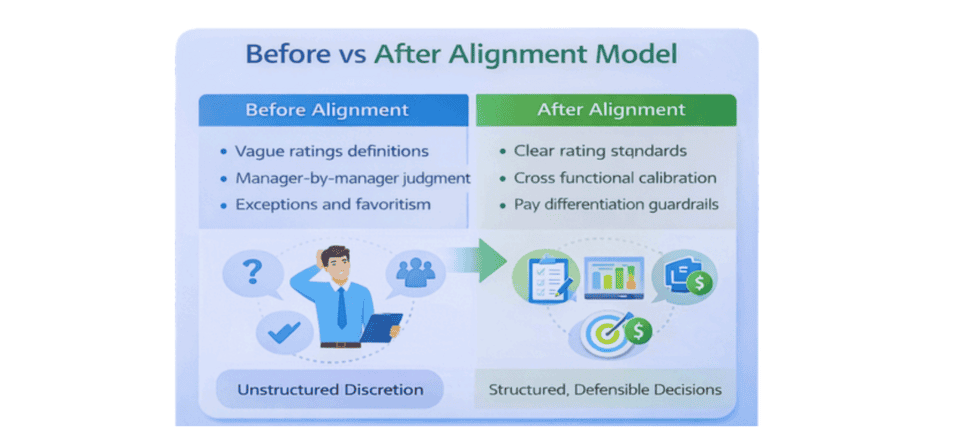
Without structured calibration, performance standards vary widely across teams, functions, or geographies.
Symptoms include:
One team rating conservatively while another rates generously
Similar performance receiving different ratings depending on manager No shared definition of what “exceeds expectations” truly means
Impact:
Internal equity issues arise, and pay outcomes become difficult to defend. 1.4 Unstructured Manager Discretion
Manager judgment is essential; but without guardrails, discretion becomes risk. Unstructured discretion leads to:
Favoritism or unconscious bias
Over-rewarding visible or vocal employees
Under-rewarding consistent contributors
Impact:
Decisions become harder to explain, justify, or defend — especially under scrutiny.
Calibration Best Practices: Restoring Consistency and Fairness
Calibration is the bridge between performance assessment and fair compensation outcomes. When done well, it aligns standards, reduces bias, and protects equity.
2.1 Purpose of Calibration
Effective calibration answers three questions:
- Are performance standards being applied consistently?
- Do pay outcomes reflect meaningful performance differences?
- Can decisions be clearly explained and defended?
Calibration is not about forcing distributions — it is about aligning judgment. 2.2 Cross-Functional Calibration Sessions
Strong calibration brings managers together to review performance outcomes across teams.
Best practices include:
Facilitated sessions led by HR or Reward Leader
Review of ratings before pay is applied
Challenge and discussion of outliers
Focus on evidence, not advocacy
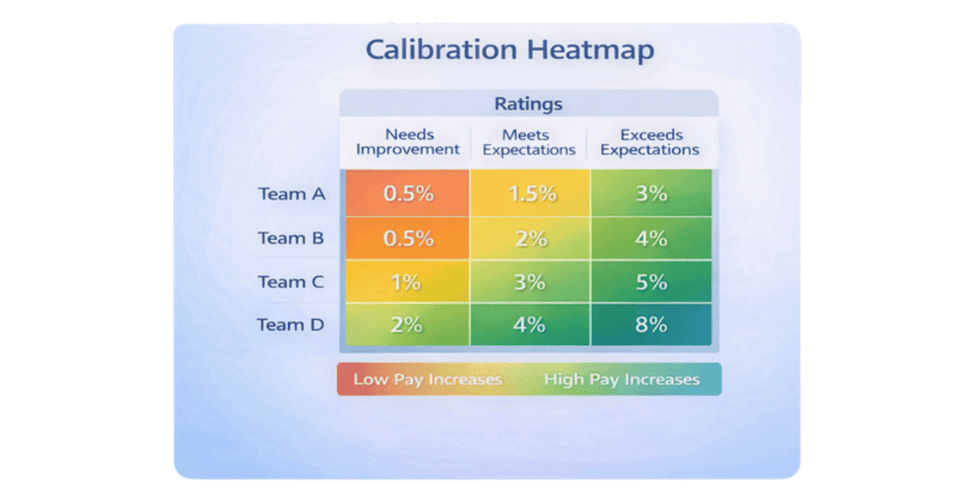
A multi-team calibration table showing ratings normalization across departments.
2.3 Clear Rating Definitions
Calibration fails when rating criteria are vague.
High-performing organizations define:
What success looks like at each rating level
Expected behaviors and outcomes
Clear examples of “meets” vs “exceeds”
This ensures managers calibrate against shared standards and not personal interpretation.
2.4 Pay Differentiation Guardrails
To preserve pay-for-performance integrity, guardrails must be explicit. Examples include:
Minimum and maximum increase ranges by rating
Clear differentiation expectations (e.g., top performers should see materially higher increases)
Limits on off-cycle exceptions
Guardrails do not remove discretion — they make discretion defensible. 2.5 HR-Facilitated Review
HR plays a critical role in calibration by:
Monitoring consistency across teams
Flagging equity risks
Challenging unsupported decisions
Ensuring outcomes align with policy and budget
This shifts HR from administrator to steward of fairness.
Linking Goals, Performance Outcomes, and Rewards
True alignment happens when goal-setting, performance evaluation, and compensation are treated as a connected system — not separate processes.
3.1 Strategic Goal Alignment
Performance goals should reflect organizational priorities.
Best practice includes:
Weighting goals based on strategic importance
Balancing business, team, and individual objectives
Adjusting goals as priorities shift
When goals are misaligned, pay outcomes lose strategic value.
3.2 Translating Performance Into Pay
High-performing organizations explicitly map performance outcomes to pay ranges. This includes:
Defined merit ranges by rating
Clear rules for positioning within a range
Consideration of market position and internal equity
Employees don’t need to see formulas — but leaders need them to ensure consistency.
3.3 Transparent Rationale
Employees are more likely to accept outcomes they understand. Strong organizations equip managers to explain:
How performance influenced pay
How budgets and guidelines were applied
Why outcomes may differ from expectations
Transparency builds trust — even when increases are modest.
4. Real-World Alignment in Practice
Organizations that successfully align pay and performance share common traits:
Structured calibration replaces ad hoc review
Pay decisions are supported by data, not spreadsheets
Managers operate within clear guardrails
HR maintains visibility and oversight
Decisions are documented and audit-ready
Observed outcomes include:
Clearer differentiation
Shorter compensation cycles
Reduced employee disputes
Higher confidence among leaders and managers
5. Framework Summary: What “Good” Looks Like
A mature pay-performance alignment framework includes:
- Clear performance standards
- Structured calibration processes
- Explicit pay differentiation rules
- Integrated goal, performance, and reward design
- Transparent, defensible decision-making
When these elements work together, compensation reinforces performance — instead of undermining it.