
Visibility That Drives Better Decisions
EXECUTIVE BRIEF
Improve visibility for leaders. Make better compensation decisions in real time.
Visibility is the difference
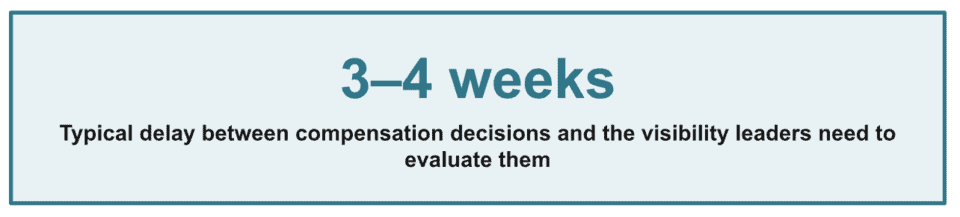
Compensation decisions are only as good as the visibility behind them. When leaders can see what’s happening across the cycle in real time, they make better calls. When they’re reading reconciliation reports three weeks later, the calls have already been made — and the consequences are already in motion.
This brief outlines where most teams lose visibility, what it costs them, and how modern compensation platforms close the gap.
Where visibility breaks down
Three patterns show up in teams running comp without a real-time visibility layer:
Vertical-only sight
Each manager sees their own team. Total Rewards sees the aggregate. But almost no one sees across departments — which is where pay equity issues, internal arbitrage, and budget imbalances actually live. Cross-departmental visibility is where the most important decisions get made, and it’s often the one view nobody has.
The delayed pulse
Reports run after the cycle. Reconciliation happens after sign-off. By the time leadership understands what was actually approved, the window to adjust has closed. Decisions get audited, not steered.
The averages trap
Dashboards show averages — average increase, average budget utilisation, average band placement. Averages hide the outliers. The outliers are where the problems are.
Real-time visibility vs. lagged reporting
The shift from reconciliation-based reporting to in-cycle visibility changes how leaders engage with compensation entirely. It’s not a reporting upgrade. It’s a different operating model.
| Lagged reporting | Real-time visibility |
| Numbers visible after sign-off | Numbers visible during planning |
| Issues surface in reconciliation | Issues surface in time to act |
| Cross-departmental views require analyst time | Cross-departmental views always available |
| Outliers hidden in averages | Outliers flagged automatically |
| Leadership reviews historical data | Leadership steers the cycle live |
| Adjustments happen next cycle | Adjustments happen this cycle |
What visibility makes possible
When the visibility layer is built in — not added on after the fact — three capabilities become routine:
Real-time budget tracking
Leadership sees budget utilisation update as managers make decisions. Overspend doesn’t surface in a reconciliation meeting. It surfaces in the planning view, with time to address it.
Equity and outlier detection
The platform highlights pay gaps, band placement anomalies, and cross-departmental inconsistencies as they emerge. Compensation teams act on real signals, not retrospective findings.
Confidence at sign-off
When leadership reviews the final cycle, the numbers are familiar — they’ve watched them resolve. Sign-off becomes a confirmation, not an audit.
The leadership view
For CHROs and Total Rewards leaders, the visibility shift changes the conversation:
- From explaining what happened to deciding what should happen
- From defending the cycle to driving the cycle
- From answering board questions reactively to anticipating them
- From data requests to dashboards
- From after-the-fact audits to during-the-cycle steering
Improve visibility for leaders. Make better compensation decisions.
Visibility isn’t a reporting feature. It’s the foundation that makes confident, defensible compensation decisions possible — at the speed business actually moves.
What to do next
If your current compensation cycle gives leadership real-time visibility, you’re in a small group. If it doesn’t — and reports arrive weeks after decisions — the cost shows up in delayed reactions, retroactive adjustments, and difficult board conversations.
CompLogix gives compensation teams and their leaders the visibility to make decisions during the cycle, not after it. Built for mid-market and enterprise teams. Deployed in weeks. Backed by dedicated U.S.-based support.

CompLogix • Compensation planning that actually works for you. • complogix.io