
Your HRIS Is Not Your Comp Platform
An HRIS stores what happened. Compensation needs a system that decides what should happen next.
The category confusion that costs teams time
Most HR and Total Rewards teams started running compensation cycles inside their HRIS because it seemed logical. The data was already there. The vendor said the module could handle it. The implementation team built something. The cycle started.
Then reality showed up. Complex eligibility rules didn’t fit. Approval flows didn’t match how the business actually operates. Manager experience was poor. Side-car spreadsheets reappeared. The HRIS module became another constraint to work around, not a tool that simplified the work.
The confusion is structural. An HRIS is built to manage employee records — payroll, history, compliance. Compensation planning is a different problem. It requires modelling, approvals, manager workflows, and real-time budget visibility. Those are different system requirements.
System of record vs. system of decision
The two systems serve fundamentally different purposes. Trying to force one to do the other’s job is what creates the operational friction most teams experience during cycle time.
|
HRIS — System of Record |
CompLogix — System of Decision |
|
Built to store what happened |
Built to decide what should happen |
|
|
|
|
CompLogix integrates with your HRIS. It pulls the master data, supports the cycle, and provides the outcomes. You keep your HRIS as the system of record. CompLogix becomes the system that runs the decisions on top of it.
Where the HRIS module breaks down
Four friction points show up consistently when compensation runs inside the HRIS:
Rigid configuration
HRIS comp modules are configured during implementation, often by external consultants. Once live, structural changes require change requests, vendor hours, or version upgrades.
Compensation strategy evolves faster than the platform can keep up.
Poor manager experience
HRIS interfaces are designed for HR administrators, not line managers running a planning cycle. The result is more support tickets, more training, and lower-quality decisions when managers don’t have the context they need.
Side-car spreadsheets
When the HRIS module can’t handle a scenario, teams fall back to spreadsheets — for modelling, for approvals, for adjustments. The single system of truth quietly becomes a hybrid of system, spreadsheets, and email.
Configuration latency
Even small changes — new bonus structures, eligibility tweaks, manager hierarchy adjustments
- can take weeks to move through HRIS change governance. Compensation cycles can’t wait.
Built to work with your existing HRIS
The modern approach isn’t to replace the HRIS. It’s to layer a purpose-built compensation platform on top of it. CompLogix is built for this:
- Integrates with Workday, UKG, SAP SuccessFactors, ADP, Oracle, BambooHR, and many others
- Pulls employee data, hierarchy, and history from the HRIS automatically
- Runs the planning cycle in a purpose-built environment with proper manager workflows
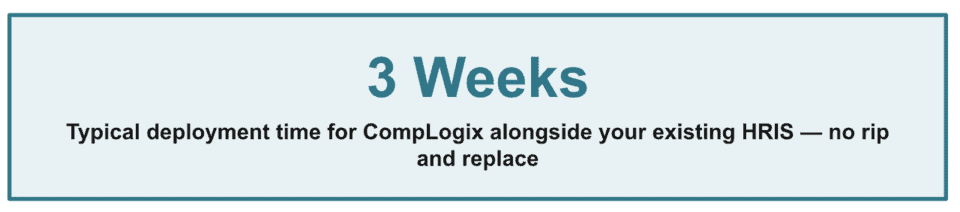
- Deploys in weeks, with a dedicated account lead — not months of consulting
- Configurable in-house by your team, not by external vendors
Works with your existing HRIS. No rip and replace. Deploy in weeks.
The two systems do what each does best. Your HRIS holds the record. CompLogix runs the decision.
What to do next
If your current compensation cycle is being squeezed through an HRIS module — and the friction is showing up in workarounds, side-car spreadsheets, or stalled plan changes — the answer isn’t to replace the HRIS. It’s to add the layer it was never designed to be.
A short conversation can map how CompLogix would fit alongside your existing infrastructure, what integration looks like, and what changes for your team during the next cycle.

CompLogix • Compensation planning that actually works for you. • complogix.io